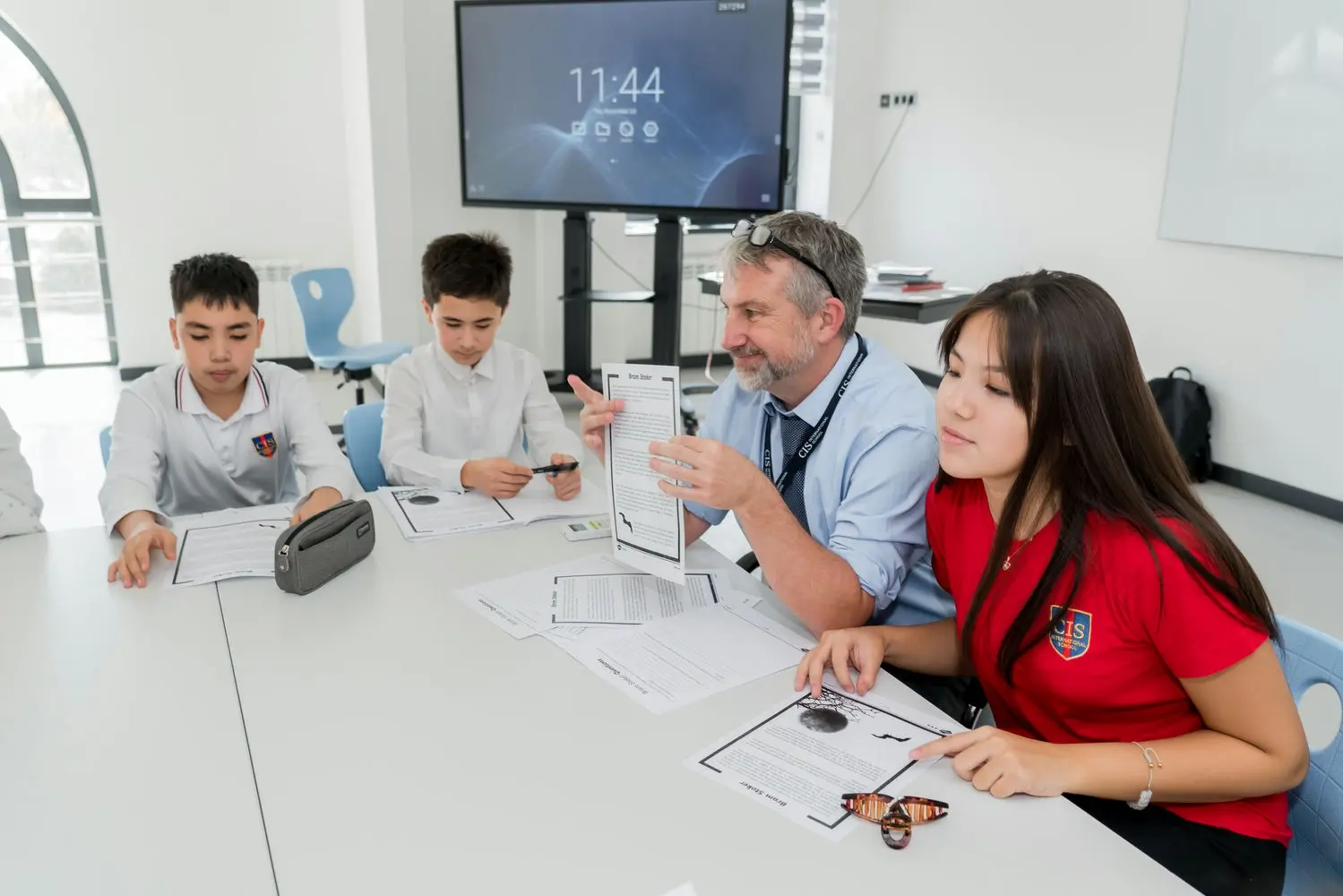
Igniting Young Minds at CIS Tashkent.
“Never stop questioning. Curiosity has its own reason for existing.”
These words by Albert Einstein capture where a true interest in science begins.
Science fairs give students the chance to do exactly that: ask questions, test their ideas, discuss results and draw their own conclusions. For many, it becomes their first experience of independent research and an opportunity to see science as a way to understand how the world works.
In February 2026, the CIS Tashkent Science Department organised the annual Science Fair for Secondary School students. Students from Year 7 to Year 10 took part, presenting a total of 40 projects. Each project reflected careful research, thoughtful analysis and genuine curiosity about the chosen topic.
During the first week, students formed teams of one to three people and selected their research topics. The themes varied widely. Some explored methods of water purification, while others focused on physical phenomena or biological processes. Students worked with sources, formulated research questions, proposed hypotheses and identified experimental variables. They then designed their investigations and prepared lists of materials, making use of the biology, physics and chemistry laboratories.
Sultan from Year 10 explains why he chose to investigate PFAS filtration (per- and polyfluoroalkyl substances — persistent chemicals that can accumulate in water and the environment):
“I believe studying PFAS filtration is important because these substances can cause serious health problems, pollute oceans and affect animals.”
The second week was dedicated to experimentation. Students conducted trial tests, refined their methods and repeated experiments in order to obtain more reliable results. Observations were carefully recorded, data organised into tables and graphs, and hypotheses tested. Teams also discussed possible sources of error and improved their procedures.
Helen, Maria and Elizaveta from Year 10 chose to explore the relationship between acidity, taste and vitamin C levels in seasonal fruits from Uzbekistan. Helen explains:
“Some people suffer from vitamin C deficiency, so our project helps identify which fruits contain more of it.”
Maria adds:
“The topic turned out to be quite complex and multi-layered, which made it especially interesting to study.”
Elizaveta notes that the project also helped her develop research skills:
“During the experiments I learned how to work carefully with data and explain results more clearly.”
Some students explored more advanced areas of science. Muhammad from Year 10 worked on an experimental measurement of Planck’s constant (a number that helps scientists understand how light and energy behave in the tiny world of particles).
“I learned how to assemble electrical circuits, work confidently with equipment and apply theory in practice,” he says.
Other teams focused on plant biology. Rakhshona and Alisa from Year 10 investigated how different wavelengths of light affect the rate of photosynthesis.
Rakhshona explains:
“Photosynthesis is the basis of life on Earth, so it is important to understand how light influences it.”
Alisa adds:
“I have always been interested in plant biology and how different lighting conditions affect plant growth.”
The final week was dedicated to preparing presentations. Students designed their displays, added models, diagrams and digital materials, and practised presenting their work clearly while answering questions. Even those who had initially felt unsure spoke confidently about their experiments and findings.
Some projects explored topics related to health. Muhammad from Year 10 investigated the effects of paracetamol on cognitive and physiological functions.
“I chose this topic to better understand how common medicines affect the body and to raise awareness about health,” he explains.
Other teams studied physical processes. Madinakhon, Farangiz and Yasmina from Year 10 explored heat loss in different materials.
Madinakhon says:
“I was interested in investigating how colour affects the way materials absorb heat.”
Farangiz notes:
“Even when our hypothesis was not fully confirmed, the experiment helped us understand the topic better.”
Yasmina adds:
“We chose this topic because we will soon be studying it in physics lessons.”
Among other notable projects were a 3D DNA model, an air-powered car, a hydraulic lift model and an experiment demonstrating how salt can be produced.
Senior students from Year 12 and Year 13 served as the judging panel, approaching the task with great care and attention.
Projects from Year 10 particularly stood out this year for their depth of analysis and thoughtful research approach.
Robert Rees Matthews, Head of the Science Department, noted that experiences like this stay with students for a long time and encourage them to view learning in a new way.
Physics teacher Darius Fyodorovich explained that students were given greater freedom in choosing their topics this year, allowing them to experience the full research journey — from the initial question to the final conclusion.
Science teacher Milad Khodabande added that taking part in the Science Fair helps students feel like real researchers and see science as a process of discovery.
Science Fair shows how academic activities beyond the classroom influence students. They experience the entire research journey — from the initial idea to the final conclusion. Gradually, their attitude towards learning changes. Confidence grows, curiosity deepens and students begin to understand that results depend on their own effort.
As Louis Pasteur once said:
“Science knows no country, because knowledge belongs to humanity, and is the torch which illuminates the world.” At CIS Tashkent, this torch is in safe hands.